
Why Beverly Hills Remains the World's Most Sought-After Address for Luxury Real Estate
There are neighborhoods that trend. Beverly Hills endures. In a world of shifting real estate narratives — cities rising and falling in global investor interest, new luxury destinations emerging across Asia, Europe, and the Gulf — Beverly Hills has maintained a position that very few addresses in the world can match. Understanding why that is true requires looking past the obvious and into the structural, geographical, and cultural factors that make this market genuinely singular.
The Case for Scarcity
Beverly Hills is not a large market. The city itself covers approximately 5.7 square miles, and the supply of trophy residential properties within it is inherently limited. There is no new land being created. The estates that exist today were largely built on lots that will never be subdivided again. The combination of geographic constraint, legacy ownership, and the cultural prestige of the address creates a supply profile that is structurally resistant to the kind of oversupply that can erode value in less constrained markets.
This is not simply a matter of perception. Scarcity at this level of quality is a real, measurable feature of the Beverly Hills market — and one that sophisticated global buyers understand instinctively when they compare Los Angeles to other cities where luxury development has diluted the supply picture considerably.
Beverly Hills in a Global Context
The global buyer evaluating Beverly Hills is not comparing it to other Los Angeles neighborhoods. They are comparing it to Mayfair, the 8th arrondissement, the Peak in Hong Kong, Geneva's Cologny, and the Palm in Dubai. Against that competitive set, Beverly Hills holds an unusual combination of advantages: a stable legal and regulatory environment, a globally recognizable address, year-round climate, proximity to one of the world's most significant entertainment and culture industries, and a level of lifestyle infrastructure — dining, retail, healthcare, education, art — that few cities can rival.
For the international buyer considering a Los Angeles acquisition, Beverly Hills also carries something intangible but real: the address communicates a level of positioning that requires no further explanation anywhere in the world. That kind of global legibility has long-term value in a way that is difficult to quantify but impossible to ignore.
Privacy as a Structural Feature
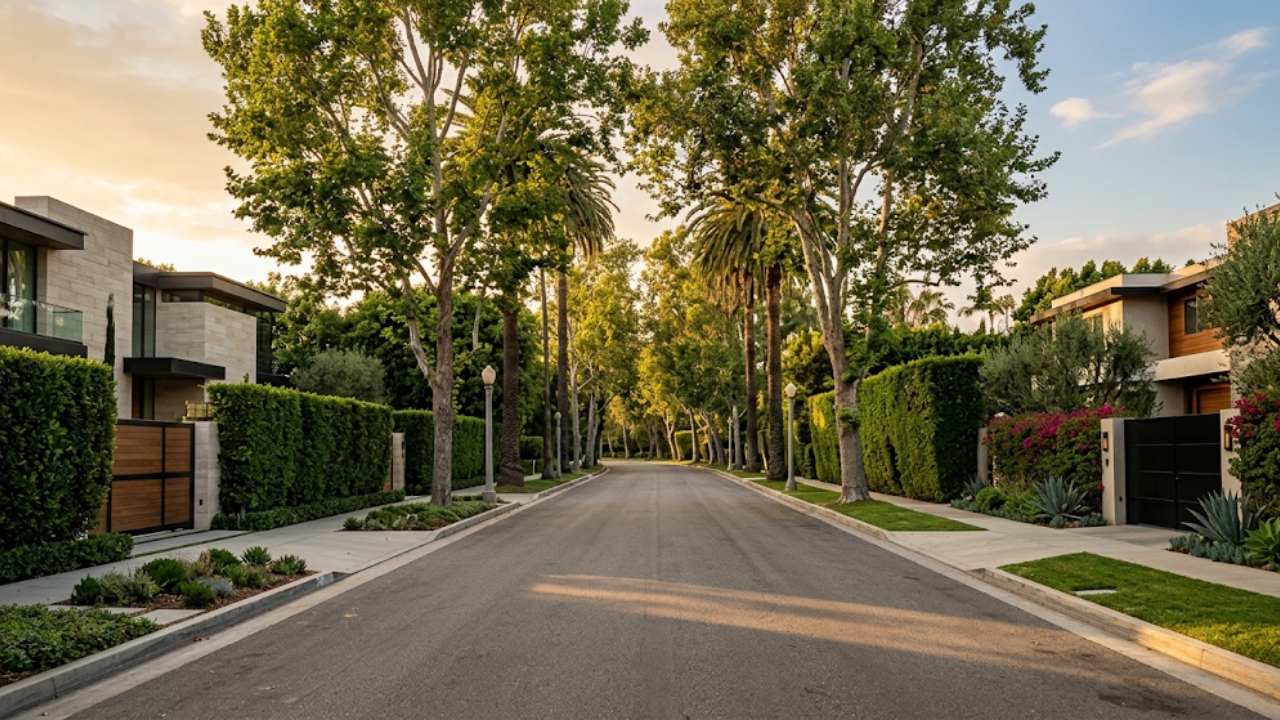
One of the underappreciated characteristics of Beverly Hills real estate — particularly in the flats and the lower hills — is the degree to which privacy has been architecturally and culturally embedded into the fabric of the neighborhood. Properties here were built with setbacks, mature landscaping, and gated entries as a standard expectation, not a premium upgrade. The lots are generous by urban standards. The streets are quiet. The infrastructure of discretion is built into the neighborhood itself.
For the high-net-worth buyer who has experienced what it means to live in a highly visible location without adequate architectural privacy, Beverly Hills represents a genuine solution. The combination of proximity to everything Los Angeles offers and the genuine sense of removal from public life is not something that can be replicated in most urban luxury markets.
What Sustains Long-Term Value
The Beverly Hills market has weathered multiple economic cycles, periods of global uncertainty, and significant shifts in buyer demographics over the past several decades. Through each of these transitions, the fundamentals have remained intact: scarcity of supply, strength of demand from both domestic and international buyers, quality of the lifestyle infrastructure, and the enduring prestige of the address.
What that history tells a thoughtful buyer is that Beverly Hills is not a market driven by momentum or speculation. It is a market driven by underlying fundamentals that have proven durable across time. This is not a guarantee of any outcome — no real estate market offers guarantees — but it is a meaningful signal about the quality of what you are acquiring when you commit to this address.
The buyers who approach Beverly Hills with the most clarity tend to be those who are not primarily focused on short-term price movement. They are thinking about a twenty-year hold, about legacy, about the kind of real estate that functions as a lifestyle asset and a long-term wealth preservation vehicle simultaneously. That framing — strategic rather than speculative — is the right lens for understanding what Beverly Hills represents.
JB's Perspective
Working in this market daily, I am continually reminded of what makes Beverly Hills different from other markets I follow globally. It is not the optics, the retail, or the celebrity association — though those things are real. It is the quiet, structural resilience of a market built on genuine scarcity, genuine lifestyle value, and a global buyer pool that continues to regard this address as a benchmark.
For buyers considering a Los Angeles acquisition at the luxury level, Beverly Hills is not simply one option among many. It is the market against which all other options are ultimately measured. Understanding what sustains that position — and how to enter it with the right timing, the right representation, and the right long-term perspective — is the work I bring to every conversation I have with a serious buyer.
Frequently Asked Questions
Why is Beverly Hills considered the top luxury real estate address in the world?
Beverly Hills holds its global position due to a rare combination of structural scarcity — limited land, legacy ownership, no new supply — alongside a universally recognized address, year-round climate, and lifestyle infrastructure that rivals the world's most established luxury cities. For international buyers comparing Los Angeles to London, Paris, or Singapore, Beverly Hills is consistently the reference point rather than simply one option among many.
Is Beverly Hills real estate a sound long-term investment?
Beverly Hills has demonstrated consistent resilience across multiple market cycles, supported by constrained supply, sustained global demand, and the enduring prestige of the address. While no real estate market can guarantee appreciation, the structural fundamentals — scarcity, lifestyle value, and deep global buyer demand — make it one of the most durable luxury markets in the world for buyers with a long-term perspective.
What types of buyers are most active in Beverly Hills luxury real estate right now?
The current Beverly Hills buyer pool includes domestic high-net-worth individuals, international families from Europe and Asia, and global investors evaluating Los Angeles as part of a broader real estate strategy. Many are comparing Beverly Hills directly to other world-class luxury addresses and choosing it for the combination of privacy, lifestyle infrastructure, and long-term capital preservation it offers — not because of trend, but because of fundamentals.
A Final Thought
Luxury real estate markets are shaped by narrative as much as fundamentals. But the strongest markets are the ones where narrative and fundamentals align — where the story the world tells about a place is supported by the underlying structural reality. Beverly Hills is one of those rare markets, and that alignment is not accidental. It is earned, over decades, by everything that makes this address genuinely worth holding.
For tailored guidance on Beverly Hills, Los Angeles, or global real estate opportunities, reach out to JB directly. He works with a select group of international and domestic buyers who value long-term perspective and market depth.
Contact JB Directly →