
What the Architecture Tells You: How Design Signals Value in Los Angeles
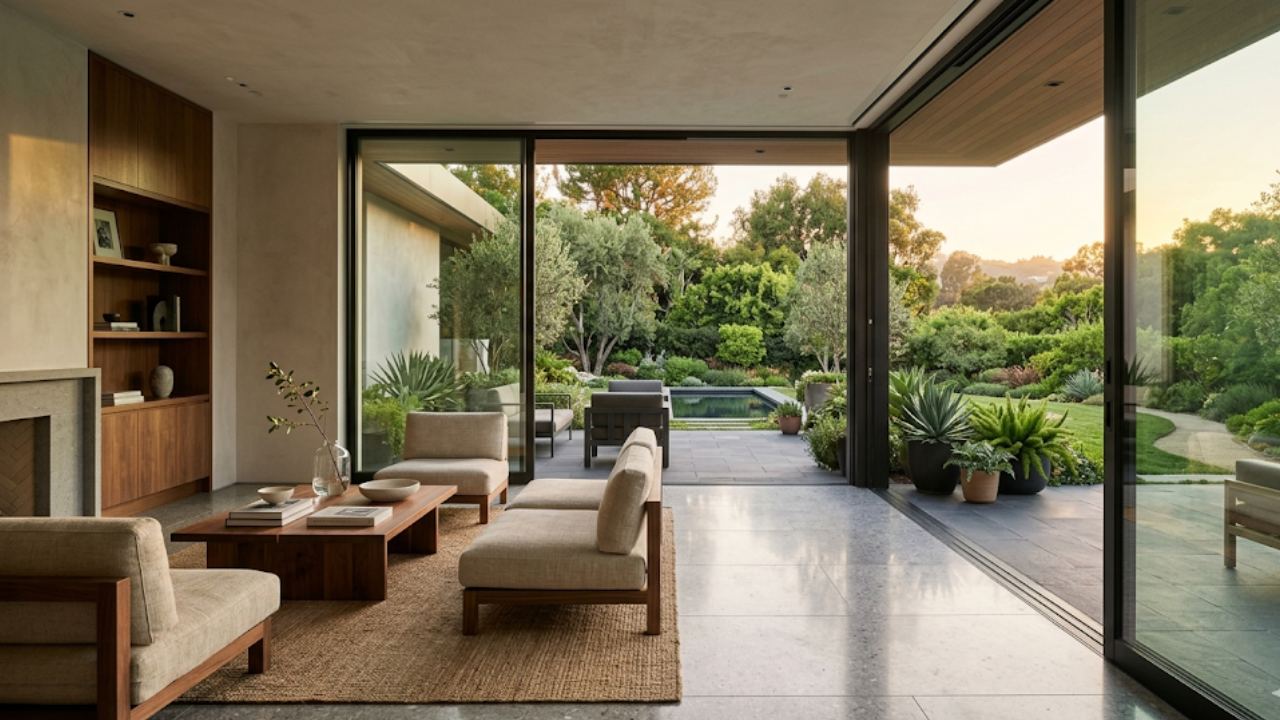
In luxury real estate, architecture is rarely neutral. It communicates intent, discipline, and long-term judgment — qualities that sophisticated buyers can read before they ever step inside a home. In Los Angeles, where the inventory is broad and buyer expectations are genuinely high, the architecture of a property often tells you more about its value trajectory than any other single factor.
Why Architecture Matters More Than Square Footage
The most common mistake in evaluating a luxury property is leading with the numbers — square footage, bedroom count, price per foot. These are useful reference points, but they do not capture what the market actually prices at the highest level.
What sophisticated buyers are purchasing is a specific kind of architectural presence: the clarity of a floorplan, the relationship between interior volumes and the landscape beyond them, the way natural light moves through a space across different times of day. These are the qualities that endure. They are also the qualities that appreciate.
A well-composed home on a considered site will hold its value — and often extend it — in ways that a larger, less disciplined property on a comparable lot will not. This is not a subjective opinion. It is what the highest-tier transactions in Beverly Hills, Bel Air, and Trousdale Estates consistently demonstrate.
The Los Angeles Context
Los Angeles has a particular relationship with architecture. The city has produced a serious canon — from the Case Study Houses to the mid-century estates of the Hollywood Hills to the contemporary work now reshaping the hilltops of Bel Air and Benedict Canyon. Buyers who understand this context bring a different level of discernment to their search.
Increasingly, this applies to international buyers as well. Clients arriving from Europe, from Hong Kong, from Singapore — markets where architectural heritage carries significant cultural weight — come to Los Angeles with a trained eye. They are not simply buying real estate. They are acquiring a piece of a city that has, over time, built a genuine architectural identity.
This is a meaningful shift in buyer behavior. It raises the standard for what qualifies as a considered acquisition at the top of the market.
What Buyers Are Actually Evaluating
In the current Los Angeles luxury market, the properties that move with confidence — and at or above asking — tend to share a recognizable set of architectural qualities.
Indoor-outdoor integration remains one of the defining values. Not as a casual amenity, but as a structural logic: the way a great room opens to a terrace, the transition from kitchen to garden, the private courtyard that creates separation without isolation. In Los Angeles, this integration is not merely desirable — it is fundamental to how residents actually inhabit the property across every season.
Site orientation and privacy are equally decisive. Where a home sits on its land, how it manages light and views while limiting exposure to adjacent properties — these decisions shape the daily experience of the property in ways that no renovation can easily correct. A home that was thoughtfully sited from the beginning carries that advantage indefinitely.
Material quality and restraint also signal value in ways that finishes and fixtures alone cannot. The most compelling properties tend to work with a limited palette, executed with exceptional craft. They are not maximalist. They communicate confidence through selection rather than accumulation.
Design as a Long-Term Strategy
From an advisory standpoint, I encourage buyers to approach architectural quality not as an aesthetic preference but as a long-term positioning decision.
Properties with strong architectural bones retain liquidity in ways that trend-dependent interiors do not. When the market softens — and every market does, periodically — it is the properties with genuine architectural merit that experience the least erosion in value and the fastest recovery. The architecture provides a floor.
For sellers, the inverse is equally true. Understanding what your property's architecture communicates — and positioning it accordingly — is one of the highest-leverage decisions in a luxury transaction. The right buyer for an architecturally significant property is not necessarily the buyer with the largest budget. It is the buyer who understands what they are acquiring. Reaching that buyer requires a different kind of representation.
JB's Perspective
I have spent considerable time working with buyers and sellers across Los Angeles, and across international markets where architecture carries a similar weight — Paris, certain neighborhoods in Hong Kong, select areas of Bali and Southeast Asia. What strikes me consistently is how universal the underlying criteria are, even when the specific styles differ.
Buyers who approach real estate with genuine seriousness are always asking the same fundamental question: will this property age well? Will it remain relevant, livable, and desirable across time? These are not sentimental questions. They are investment-grade questions. And the answer almost always begins with the architecture.
In Los Angeles, we have the full range — properties that will hold their position in the market for generations, and properties that are dressed to impress in the short term. My work is to help clients distinguish between the two, and to position transactions accordingly.
Final Thought
Architecture is the most durable form of value in luxury real estate. It does not fade with a market cycle, and it cannot be replicated by renovation alone. In a market as layered and competitive as Los Angeles, the ability to read architectural quality — and act on it — is one of the clearest advantages a buyer or seller can carry into a transaction.
The numbers tell part of the story. The architecture tells the rest.
For a private conversation about architectural value and positioning in the Los Angeles luxury market, connect with JB directly.
style="color: #8B7355; font-weight: 500; text-decoration: none; border-bottom: 1px solid #C9B99A;">Get in Touch